Posts

ISO/IEC 42001: Artificial Intelligence Management System — The Ultimate Guide to Responsible AI Governance

Image
  ISO/IEC 42001 establishes requirements for an Artificial Intelligence Management System (AIMS) to ensure ethical, transparent, and accountable AI deployment across organizations. Published in December 2023 by ISO and IEC, this standard addresses AI's rapid evolution by providing a certifiable framework for managing risks and opportunities. Introduction to ISO/IEC 42001 ISO/IEC 42001:2023 marks the world's first international standard dedicated to AI management systems, applicable to any organization developing, providing, or using AI-based products or services. It defines an AIMS as interrelated elements that set policies, objectives, and processes for responsible AI development, provision, or use. Unlike technical AI standards like ISO/IEC 22989 (terminology) or ISO/IEC 23894 (risk management), ISO/IEC 42001 adopts a management system approach using the Plan-Do-Check-Act (PDCA) cycle for holistic governance. The standard responds to AI's transformative potential in secto...

AI Governance Framework: Designing Accountability, Transparency, and Safety in Next-Generation AI Systems

Image
  Artificial intelligence has rapidly progressed from experimental prototypes and isolated predictive models into a pervasive infrastructure embedded across industries, public institutions, and digital ecosystems. AI is now used to screen loan applicants, determine insurance pricing, shape recruitment decisions, detect fraud, analyze medical reports, personalize learning pathways, and even design organizational workflows autonomously. As systems evolve toward higher-order autonomy, greater interpretive complexity, and interdependent decision flows, traditional forms of oversight and risk management are no longer sufficient. AI Governance Frameworks have emerged as the structural blueprint for ensuring that AI systems are developed, deployed, and operated with accountability, transparency, equity, and measurable safety. These frameworks act as institutional guardrails through which organizations can systematically regulate the ethical and operational integrity of machine-driven deci...

Why Every Organization Needs an AI Governance Framework & AI Risk Management Framework in 2025

Image
 As artificial intelligence continues to reshape industries, governing AI responsibly is no longer optional — it’s a necessity. Whether you're building a chatbot or deploying complex predictive algorithms, you need both an AI governance framework and an AI risk management framework to stay compliant and trustworthy in the digital age. ✅ What is an AI Governance Framework? An AI governance framework is a structured approach that helps organizations define policies, responsibilities, and ethical boundaries around AI systems. Think of it as the rulebook for how your organization designs, builds, and monitors AI tools. It focuses on: Transparency & explainability Accountability & oversight Ethical considerations Data governance Compliance with regional and global laws (like the EU AI Act, NIST, ISO 42001, etc.) 🚨 Why You Need an AI Risk Management Framework Too While governance sets the vision, AI risk management handles the execution. An AI risk ...

Colorado AI Law Hits U.S. First—Here's What You Need to Know

Image
Colorado has taken bold steps in AI governance, enacting the nation’s first comprehensive Colorado ai law - formally the Colorado Artificial Intelligence Act (CAIA), signed on May 17, 2024 , and set to take effect February 1, 2026 The law targets high‑risk AI systems -  those that directly influence consequential decisions in education, employment, insurance, healthcare, housing, government services, legal aid, and finance. Under CAIA, both developers and deployers must exercise “reasonable care” to prevent algorithmic discrimination , defined as unlawful bias based on protected characteristics like race, gender, age, or disability. Key Obligations Include: Transparency disclosures to users when interacting with AI systems (beyond high‑risk use cases). Annual impact assessments for high‑risk systems, covering data sources, performance metrics, monitoring, and mitigation plans. Incident reporting to the Attorney General and affected parties within 90 days if discrimination...

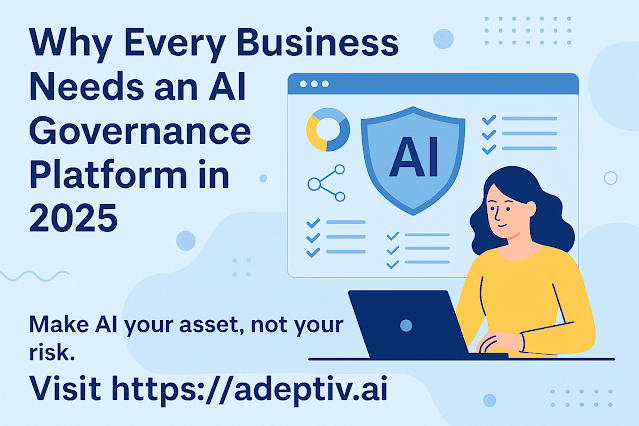
Why Every Business Needs an AI Governance Platform in 2025

Image
 As artificial intelligence continues to evolve, so does the responsibility of using it wisely. In today's data-driven world, deploying AI without a solid foundation of governance is like sailing without a compass. This is where an advanced AI governance platform comes into play. At Adeptiv.ai , we're pioneering solutions that empower businesses to innovate with trust. Our platform offers a structured approach to AI data governance , ensuring your AI systems are transparent, ethical, and fully compliant with industry standards. Whether you're dealing with sensitive customer data or deploying predictive models at scale, Adeptiv’s tools help you: Manage data quality and integrity Mitigate algorithmic bias Maintain audit trails and model explainability Align with global AI regulations With AI expanding into every corner of business, choosing the right AI governance platform is no longer optional — it's essential. Make AI your asset, not your risk. Visit ...